
In 2026, the conversation around content creation has taken a new shape. With AI writing tools now mainstream, many are asking a pressing question: Can artificial intelligence truly outperform human writers? Or are we simply witnessing a shift in how content gets created?
This article explores the strengths and limitations of both, using data and practical comparisons. And for anyone considering creating content or launching a blog, these insights can guide smart decisions on where to begin and what tools to use.
What Defines Great Writing in Today’s Landscape?
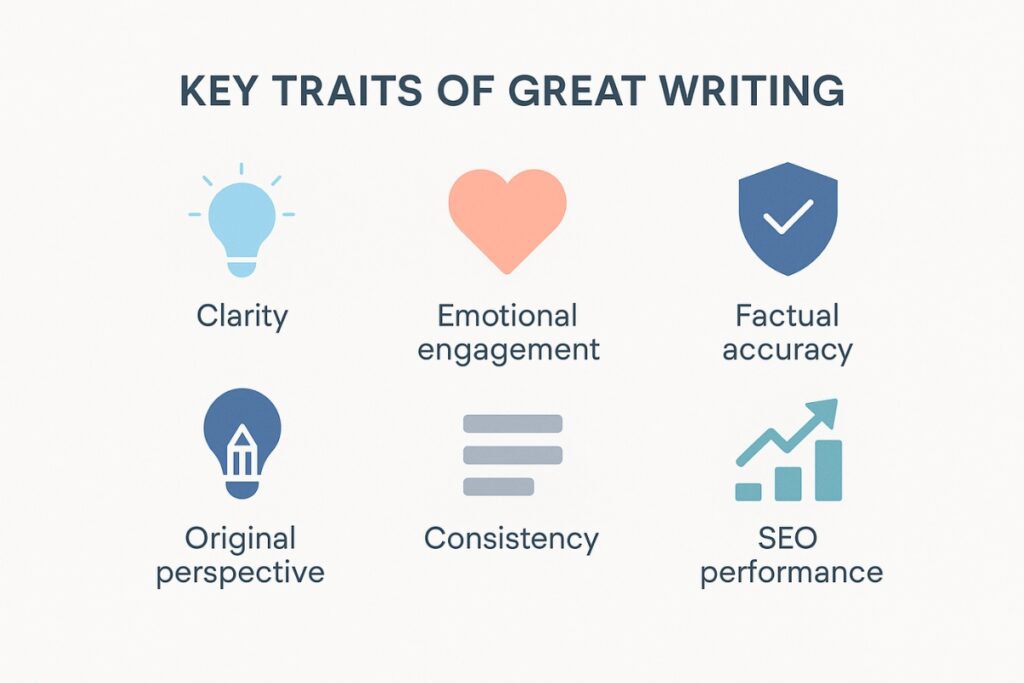
What Defines Great Writing in Today’s Landscape?
Before diving into comparisons, it’s worth understanding what actually makes writing “great” or effective in today. These are the qualities most valued by readers and algorithms alike:
- Clarity and ease of reading
- Emotional engagement
- Factual accuracy
- Original perspective
- Consistency and structure
- Strong performance in search engines, a principle at the heart of local SEO and general content strategy alike, is essential for content that actually gets seen.
Each of these factors plays a role in content success. Butwhich one delivers more of them?
Where AI is Ahead
AI’s biggest strength is efficiency. It can produce large volumes of content in minutes, making it ideal for drafting outlines, generating product descriptions, or creating quick social posts.
AI tools also excel in clean formatting, grammar, and structural consistency. These models are trained on massive datasets, so they mimic patterns well and stick to standard rules of writing.
For fact-based summaries or educational overviews, AI is often capable of generating basic content with impressive speed. That’s why it’s frequently used in newsrooms and marketing teams to produce short-form or semi-structured content.
AI tools can also generate content ideas at scale, using systems similar to ChatGPT for local content marketing strategies or blog pipelines.
AI tools can also generate content ideas at scale, using systems similar to ChatGPT, a powerful way to feed local content marketing strategies or blog pipelines.
Where Human Writers Still Hold the Edge
Human writers bring nuance that machines can’t replicate. Emotional tone, humor, cultural references, and subtle context are all areas where human thinking outperforms AI.
More importantly, humans are better at creating original thought. AI is trained to remix and predict based on existing patterns, not to invent new angles or argue complex perspectives.
In long-form content, human writers are more capable of maintaining a consistent voice and guiding the reader through layered ideas. They know how to build toward a key insight, use storytelling to hold attention, and adjust the tone for different audiences.
Lastly, human judgment remains essential for fact-checking and questioning assumptions. While AI can produce confident statements, it sometimes makes factual errors that go unnoticed unless manually reviewed.
What the Research Shows
Studies comparing AI and human writing have revealed interesting trends. AI-generated content often scores high on structure and grammar. However, it falls behind in areas like emotional depth, creativity, and coherence over longer formats.
Readers tend to rate human-written pieces as more engaging and trustworthy, particularly when the topic is subjective or requires a strong point of view.
AI detection tools also show that while machine content can be convincing, trained eyes and refined algorithms can still spot it. Many detection tools still misclassify content, but overall, the difference in tone and flow is noticeable to experienced editors and marketers.
In the education and publishing industries, research continues to favor human content in scenarios where originality and engagement matter most.
A Quick Comparison
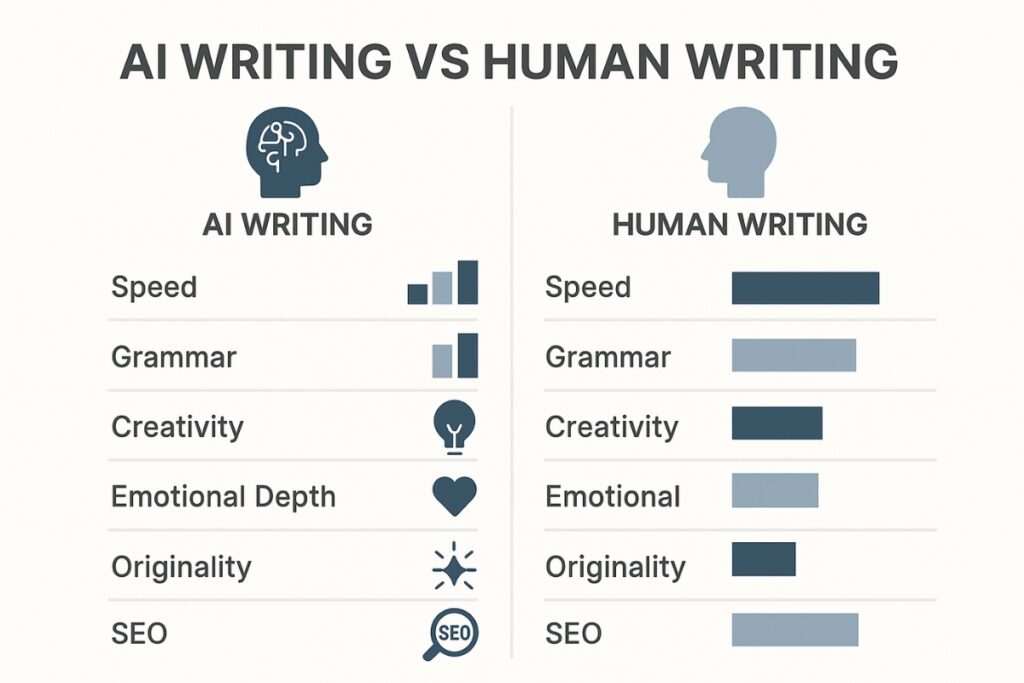
| Feature | AI Writers | Human Writers |
| Speed and output | High | Moderate |
| Grammar and structure | Clean and stable | Good but variable |
| Emotional engagement | Low | Strong |
| Originality | Remixed ideas | Fresh insights |
| Narrative coherence | Inconsistent | Reliable |
| Factual accuracy | Requires checking | High with review |
| SEO optimization | Strong with tools | Strong with intent |
How Smart Creators Are Using Both
The best content teams today are not picking one side. They are combining both. AI is used to speed up the production process, generate drafts, and handle research tasks. Human editors then step in to refine the tone, inject creativity, and ensure accuracy.
Some content teams report scaling draft production several times over by using AI. However, engagement only truly soared after human writers layered in thoughtful intros and calls to action, a pattern consistent with research that shows human-generated content tends to drive stronger audience response.
For aspiring bloggers or content creators, this approach works beautifully. AI can handle the heavy lifting early on, helping to brainstorm, organize, or write first drafts. From there, human input takes the content to the next level with sharper insights, better stories, and clearer messages.
This hybrid workflow doesn’t just produce more content. It creates better content that reflects personal expertise while saving time.
The smartest writers aren’t worried about AI replacing them. They’re using it to write smarter, faster, and deeper.
The Opportunity for New Voices

As AI-generated content becomes more widespread, truly authentic writing is becoming more valuable. This creates a unique opportunity for new writers to cut through the noise with content rooted in personality and real experience.
This makes it an ideal time for new writers and creators to step into the space. Even simple blog posts that follow an evergreen content strategy, rooted in personal insight rather than generic AI output, have a real chance to outrank machine-like articles.
For those thinking about starting a blog or content brand, the timing is excellent. Tools are more accessible than ever, and audiences are hungry for genuine connection.
There’s no need to write like a literary expert. Just a clear voice, a consistent message, and a focus on delivering value can go a long way.
What’s Next for AI and Writing?

AI will continue to improve. Future models may better capture emotional tone, reduce factual errors, and even handle long-form content with more consistency. But even the most advanced models will rely on human oversight, taste, and strategy.
Content creators who understand how to use AI as a tool, rather than a replacement, will stay ahead. Those who master their voice, build trust with their audience, and continue to refine their skills will always have an edge, no matter how powerful the technology becomes.
One challenge emerging in local SEO is maintaining originality across multiple location pages. AI can assist with structural templates and research, but human writers are still key to differentiating content that ranks from content that blends in.
The Bottom Line
AI isn’t here to replace human writers. It’s here to support them. The most effective content today is created through collaboration, machines for speed and structure, humans for depth and connection. Writers who master the blend of speed and soul in their process will lead the next wave of content creation.
Frequently Asked Questions
Not entirely. While AI can produce structured content, it still lacks creativity and emotional nuance. Human input remains essential for high-impact writing.
Yes, especially for drafting outlines, generating topic ideas, or writing basic content. However, blog posts still perform best when they include a human perspective, editing, and storytelling. A hybrid approach is usually most effective.
AI content often lacks emotional tone, includes generic phrasing, and may miss subtle context or logical flow. Detection tools exist, but they’re not always accurate. Human-written content tends to feel more personal and connected.
The biggest risks are factual errors (hallucinations), overuse of generic language, and loss of brand voice. Without human oversight, AI content can feel flat, repetitive, or even misleading.
Yes. AI can help brainstorm, rephrase, outline, or even edit drafts. Many writers use AI as a supportive tool to improve productivity and structure, while still keeping the creative control in human hands.
Anything involving original thought, opinion, brand storytelling, humor, emotional nuance, or complex narrative structure is better handled by a human. These elements are difficult for AI to replicate authentically.