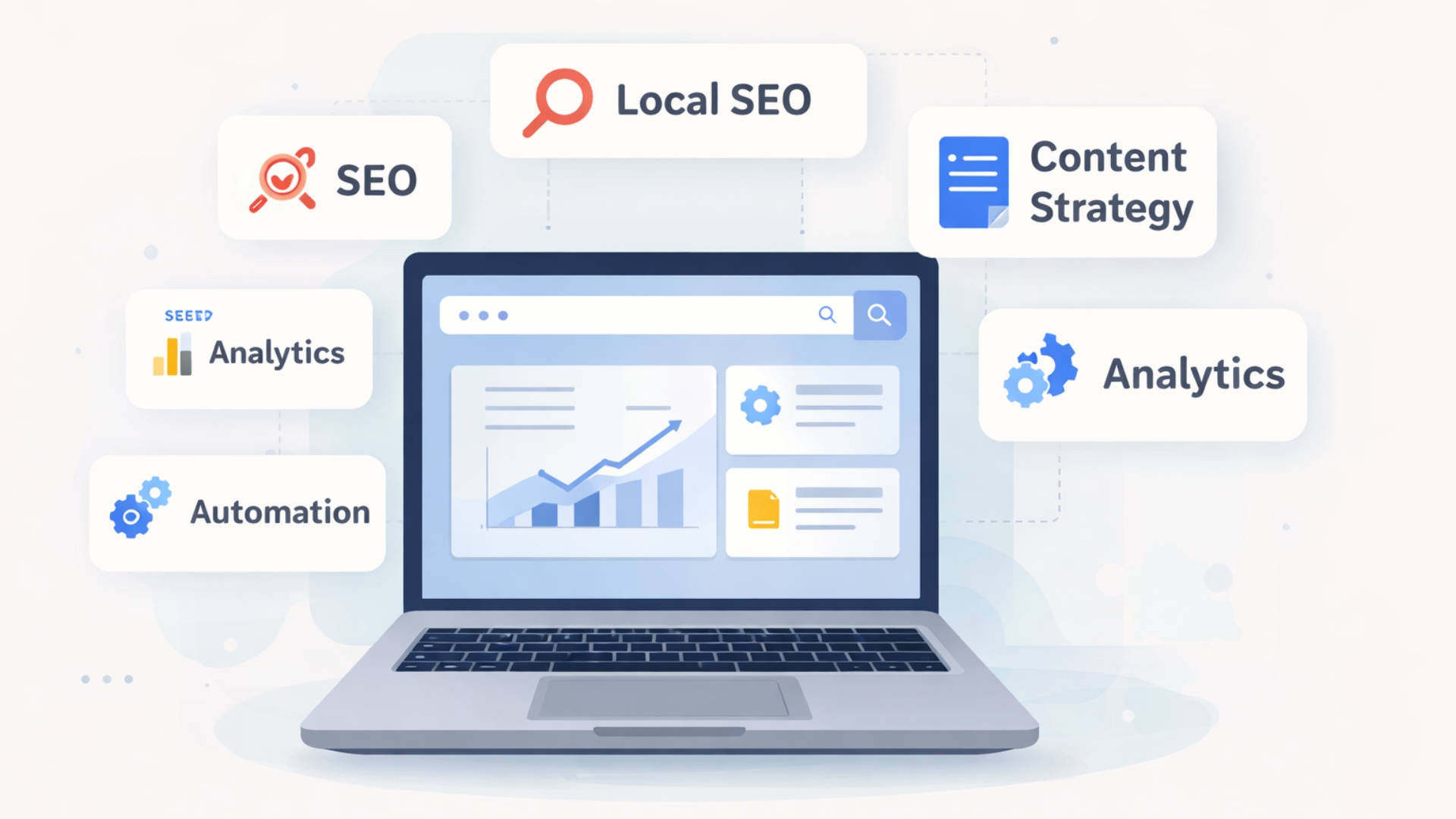
Running a small business today means hearing a lot of marketing terms thrown around, such as SEO, content funnels, organic traffic, and automation. The problem is that most explanations are written for marketers, not business owners.
This guide exists so you do not have to leave the site and Google a term every time you see it mentioned in another article.
Bookmark this page. Any time you come across a digital marketing term you don’t recognize, you can return here for a clear explanation and links to deeper guides when you are ready to learn more.
Jump to the section or term you need:
Website & SEO Basics
Your website is the foundation of your online presence, and most digital marketing efforts eventually point back to it.
For small business owners, this means your website is not just a digital brochure. It is where trust is built, actions are taken, and potential customers decide whether to contact you, book a service, or move on.
Whether you’re writing blog posts, running ads, or optimizing for search, these concepts affect how your site is structured, how it appears in search results, and how users interact with it.
Small technical or structural issues can quietly limit performance over time, even when traffic is coming in. Knowing how these elements work together makes it easier to recognize when something is underperforming and ask the right questions.
Understanding these basics helps you make informed decisions and spot problems early, even if you are not doing the work yourself.
Internal Links
Internal links connect one page on your website to another. They help search engines understand site structure and keep visitors engaged by guiding them to related content.
External Links
External links point from your site to other trustworthy websites. When used correctly, they add context, credibility, and value for readers.
Learn more:
→ Nextdoor, Reddit & Community Q&A: Underrated Local Link Opportunities
Schema Markup
Schema markup is structured data added to your site to help search engines better understand your content. It can enable enhanced search features such as FAQs and star ratings, which often improve visibility and click-through rates.
Learn more:
→ Local Schema Markup 101: Boost Click Throughs With Rich Results
Jump to the section or term you need:
Blog | Content Calendar | Content Marketing | Content Repurposing | Content Strategy | Content Strategy Template | Evergreen Content | Evergreen Content Strategy | Inbound Marketing | Local Business Content Strategy | TOFU, MOFU, BOFU
Content & Blogging Terms
Content is how small businesses attract attention, build trust, and stay visible over time. Blog posts, guides, and educational resources support SEO, email marketing, and social sharing when they are created with intention. The terms below explain how content is planned, organized, and used throughout the customer journey.
Blog
A blog is a collection of articles published on your website to answer questions, share expertise, and attract traffic. Blogs remain one of the most effective long-term tools for SEO and lead generation.
Learn more:
→ How Do Blogs Help SEO
→ Learn Blogging: A Beginner’s Guide
Content Calendar
A content calendar plans what you publish and when. It helps maintain consistency, improves SEO, and keeps marketing efforts organized.
Learn more:
→ How to Build a Content Calendar for Your Local Business
Content Marketing
Content marketing focuses on creating and sharing valuable content to attract, engage, and convert your audience over time. Instead of relying on ads alone, it builds trust by answering questions and solving real problems your customers already have.
Content Repurposing
Content repurposing means reusing existing content across multiple platforms or formats. This approach helps extend the lifespan of content while reaching different audiences without starting from scratch.
Learn more:
→ How to Repurpose Your Blog Content for Substack (and Vice Versa)
→ Best Content Scheduling Analytics Tools
Content Strategy
Content strategy is the planning behind what you publish, who it is for, and how it supports business goals. Without a strategy, content becomes inconsistent and difficult to measure.
Content Strategy Template
A content strategy template is a structured framework for planning goals, audiences, content types, and publishing schedules. Templates help teams move faster and stay consistent.
Learn more:
→ Content Strategy Template: Free Framework for 2026
Evergreen Content
Evergreen content stays relevant long after publication. It continues to generate traffic and leads for months or years without frequent updates.
Learn more:
→ How to Build a Simple Yet Effective Evergreen Content Strategy
Evergreen Content Strategy
An evergreen content strategy focuses on publishing content that remains useful over time, reducing the need for constant new posts while still supporting SEO and lead generation.
Learn more:
→ How to Build a Simple Yet Effective Evergreen Content Strategy
Inbound Marketing
Inbound marketing is a strategy focused on attracting customers through helpful, relevant content rather than interruptive advertising. It relies on content, SEO, email, and education to build trust and guide people toward taking action over time.
Learn more:
→ Inbound Marketing Software
Local Business Content Strategy
A local business content strategy focuses on attracting customers within a specific geographic area by aligning content with local search intent and community relevance.
Learn more:
→ Local Business Content Strategy: From Awareness to Appointment
TOFU, MOFU, BOFU
These terms describe content for the top, middle, and bottom stages of the funnel. Each stage supports a different part of the buyer journey, from awareness to decision making.
Learn more:
→ What Is TOFU, MOFU, BOFU Content? Why It Matters
Jump to the section or term you need:
SEO & Local SEO Terms
Business Directory Listings | Local Citation Listings | Competitor Analysis | Google Keyword Planner | Keyword Research | Local SEO | Local SEO Audit | Local SEO Ranking Factors | NAP Consistency | Ranking Factors | SEO
SEO & Local SEO Terms
SEO determines how easily people can find your business when they search online.
For small business owners, SEO affects whether your site shows up at all when potential customers are actively looking for solutions you offer. Strong SEO helps attract qualified traffic without relying entirely on paid ads or constant promotions.
Local SEO is especially important for service-based and location-focused businesses that rely on nearby customers.
Local SEO connects your business to real-world intent, such as searches that include city names or “near me” terms. When done correctly, it helps you appear at the exact moment someone nearby is ready to contact or visit a business like yours.
These terms often come up when discussing rankings, visibility, keywords, and audits, and understanding how they connect helps you focus on strategies that actually move the needle.
Business Directory Listings | Local Citation Listings
Business directory listings, also called local citation listings, are online profiles that display your business name, address, and phone number across directories and platforms. Accurate and consistent listings help improve local search visibility and make it easier for customers to find and trust your business.
Competitor Analysis
Competitor analysis involves studying other businesses that rank for the same keywords or serve the same audience. It helps you identify gaps, set realistic benchmarks, and uncover opportunities to improve your own performance.
Learn more:
→ Local SEO Competitor Analysis: How to Outrank Your Competition
Google Keyword Planner
Google Keyword Planner is a free tool that helps identify search terms people use on Google. It is commonly used to estimate search demand, discover keyword ideas, and understand how competitive certain keywords may be for SEO and advertising.
Learn more:
→ Google Keyword Planner: Beginner’s Guide
Keyword Research
Keyword research identifies the words and phrases people use when searching online. It helps ensure your content matches real demand instead of guessing what potential customers want to see.
Learn more:
→ Keyword Research for Local Businesses: A Beginner’s SEO Guide
Local SEO
Local SEO focuses on ranking for geographic searches such as city names or “near me” queries. It helps nearby customers find your business at the exact moment they are looking for services you offer.
Learn more:
→ How Local SEO Works (And Why It Matters for Service-Based Businesses)
→ Best Tools for Scaling Local SEO Content Marketing
→ Free Local SEO Tools for Small Businesses
Local SEO Audit
A local SEO audit reviews your website, listings, and overall local visibility. It helps uncover hidden issues that may be limiting rankings, traffic, or conversions.
Learn more:
→ Planning Your First Local SEO Audit (DIY)
Local SEO Ranking Factors
Local SEO ranking factors specifically influence map results and local search visibility. These factors determine which businesses appear first when users search for services nearby.
NAP Consistency
NAP stands for Name, Address, and Phone Number. Keeping this information consistent across the web builds trust with search engines and reduces confusion for customers.
Learn more:
→ NAP Consistency: Guide to Achieving Great Local SEO Rankings
Ranking Factors
Ranking factors are signals search engines use to decide how pages and businesses are ordered in search results. Understanding these factors helps you prioritize efforts that actually influence visibility instead of chasing trends.
Learn more:
→ Google Business Ranking Factors in 2025
→ Yelp Ranking Factors in 2025
SEO (Search Engine Optimization)
SEO is the process of improving your website so it ranks higher in search engine results. It helps increase visibility, attract qualified traffic, and support long-term growth without relying entirely on paid ads.
Relevant content:
Jump to the section or term you need:
Google Business Profile & Reviews
Duplicate Listings | Google Business Profile | Google Map Pack | Reviews | Suspended Google Business Profile
Google Business Profile & Reviews
For many small businesses, Google Business Profile is the most visible part of their online presence. It often appears before a website in search results and plays a major role in local discovery.
Reviews and profile details directly influence trust, click behavior, and local search visibility, making this section especially important for service-based businesses.
Duplicate Listings
Duplicate listings occur when multiple profiles exist for the same business across Google or directories. These duplicates can confuse search engines, split ranking signals, and create a poor experience for customers.
Learn more:
→ Duplicate Listings: Here’s How to Merge or Remove Them Safely
Google Business Profile (GBP)
Google Business Profile controls how your business appears on Google Search and Google Maps. An optimized profile helps customers find accurate information, understand your services, and decide whether to contact you.
Learn more:
→ How to Set Up and Optimize Your Google Business Profile
Google Map Pack
The Google Map Pack is the group of local business listings that appear at the top of search results alongside a map. Appearing in the Map Pack increases visibility, clicks, and calls for service-based businesses targeting nearby customers.
Learn more:
→ How Local Lead Funnels Boost Google Business Profile Rankings
→ Local SEO for Service-Based Businesses
Reviews
Reviews are customer feedback left on platforms such as Google and Yelp. They influence rankings, credibility, and purchasing decisions, especially for businesses that rely on local trust.
Learn more:
→ The Ultimate Guide to Getting Reviews for Your Local Business
Suspended Google Business Profile
A suspended Google Business Profile occurs when Google removes a listing from public search due to policy violations or verification issues. Suspensions can significantly impact visibility and lead flow until the issue is resolved.
Learn more:
→ Suspended Google Business Profile: Causes and Recovery Guide
Jump to the section or term you need:
Funnels, Email & Automation
Automation Workflow | Content Funnel | Content Funnel Audit | Email Marketing | Marketing Automation | Marketing Funnel
Funnels, Email & Automation
Traffic alone is not enough to grow a business. Funnels, email marketing, and automation help turn visitors into leads and customers by guiding them through a structured journey.
For many small businesses, this structure is what prevents missed opportunities. Without clear follow-ups and systems in place, interested visitors often drop off simply because no next step is defined or communication stops too soon.
These terms explain how systems work behind the scenes to nurture interest, follow up consistently, and reduce manual work.
Automation Workflow
An automation workflow is a sequence of actions triggered by user behavior, such as form submissions or email clicks. These workflows ensure timely follow-ups and consistent communication without manual intervention.
Learn more:
→ How to Use Automations + Content Marketing to Generate Leads
Content Funnel
A content funnel guides visitors from first contact with your business to taking a specific action. It helps align content with different stages of awareness, consideration, and decision making.
Learn more:
→ Local Business Content Strategy: From Awareness to Appointment
Content Funnel Audit
A content funnel audit evaluates how well your existing content supports conversions. It highlights where visitors drop off and where improvements can increase results without creating new content.
Learn more:
→ Planning Your First Content Funnel Audit
Email Marketing
Email marketing uses email to communicate with leads and customers over time. It helps build relationships, share updates, and move people closer to taking action without relying solely on social media or ads.
→ How to Choose the Right Email Marketing Tool for Your Business in 2025
→ Best Email Marketing Services
Marketing Automation
Marketing automation uses software to manage follow-ups, emails, and workflows automatically. It allows businesses to respond to user behavior consistently while saving time and reducing manual effort.
Learn more:
→ How to Use Automations + Content Marketing to Generate Leads
→ GoHighLevel for Local Businesses
Marketing Funnel
A marketing funnel represents the full journey people take from discovering your business to becoming customers. Understanding this flow helps ensure messaging and offers match what people need at each stage.
Learn more:
→ What Is TOFU, MOFU, BOFU Content? Why It Matters
Jump to the section or term you need:
Tools, SaaS & Modern Marketing
Tools, SaaS & Modern Marketing
Modern digital marketing relies heavily on software, platforms, and automation tools. These technologies help businesses manage content, track performance, streamline workflows, and scale marketing efforts more efficiently. Understanding these terms makes it easier to evaluate tools without getting overwhelmed by features, buzzwords, or sales pitches.
AI Generated Content
AI generated content is created using artificial intelligence tools to assist with writing, research, or ideation. When used carefully, it can speed up workflows, but improper use can create quality or SEO risks.
Learn more:
→ AI Generated Content & Local SEO: What’s Safe, What’s Risky in 2025
Micro SaaS
Micro SaaS businesses focus on small, specialized software solutions that solve specific problems. These tools are often easier to manage and more sustainable for small teams or solo founders.
Learn more:
→ Micro SaaS Ideas
SaaS (Software as a Service)
SaaS refers to software that is accessed online rather than installed on a local computer. Most modern marketing tools use this model because it allows for regular updates, remote access, and easier scalability.
Learn more:
→ What Are SaaS Products?
Digital Marketing Terms: Key Takeaways
You don’t need to memorize every digital marketing term to grow your business. You just need a reliable place to reference them and a basic understanding of how they connect to your goals.
This guide will continue to grow as new tools, platforms, and strategies evolve. Bookmark it, link to it, and use it as your go-to reference whenever a term appears in another article.
When you are ready to go deeper, explore the linked guides throughout this page to start building a stronger and more sustainable marketing system.